Table of Contents:
If you arrive in Nepal in autumn, you’ll Dashain Festival in Nepal: 7 Amazing Facts, Dates and Trekking Tips
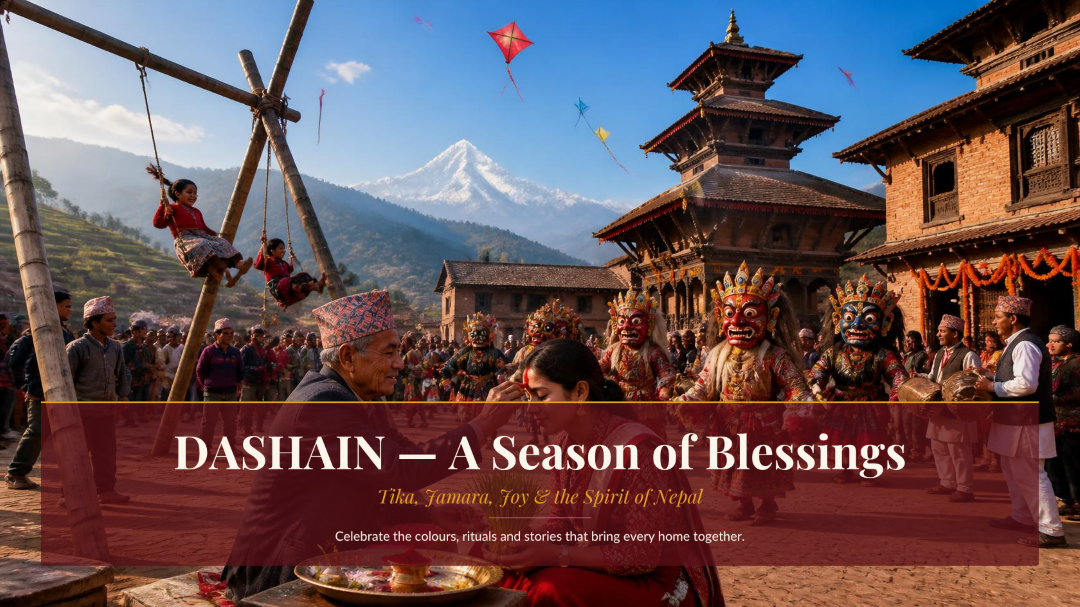
If you arrive in Nepal in autumn, you’ll sense it before anyone explains it. Kites fill the sky above the rooftops, bamboo swings rise at the edges of villages, and buses roll out of Kathmandu packed with families heading home. This is the Dashain festival, the longest, biggest and most loved celebration in the country.
The Dashain festival also arrives just as the monsoon ends and the main trekking season begins. The air is washed clean, the hills are green, and the Himalayan peaks stand out against a deep blue sky. Many trekkers stumble into Dashain by accident. At The Nepal Trekking Company, we think you should plan for it on purpose.

In this guide, we explain why the Dashain festival is celebrated, when it happens, how it is observed, how different ethnic communities mark it, and why trekking in Nepal during Dashain can be one of the most memorable journeys of your life. You can also read the background on Dashain on Wikipedia, and plan your trip with the official Nepal Tourism Board.
7 Amazing Facts About the Dashain Festival.
- It lasts 15 days. The Dashain festival runs from the first day of the bright lunar fortnight to the full moon, though the main celebrations fall on days 1, 7, 8, 9, 10 and 15.
- It has many names. People also say Dashai, Dasain, Bijaya Dashami, and Mohani among the Newars.
- It is the national festival. The Dashain festival is Nepal’s longest public holiday period, with several days off around Dashami.
- It falls in autumn. It is held in the lunar month of Ashwin, usually in September or October.
- It celebrates good over evil. The goddess Durga’s victory over a demon is the heart of the story.
- Barley shoots are sacred. The yellow jamara shoots grown at home are worn as a blessing.
- It is the biggest family reunion of the year. Millions of Nepalis travel home, which is why transport is so busy.
Why Is the Dashain Festival Celebrated in Nepal?
At its heart, the Dashain festival celebrates the triumph of good over evil. It draws on two great stories, and both are still told in homes across Nepal today.

The Goddess Durga and the Demon Mahishasura.
In the Devi Mahatmya tradition, the buffalo demon Mahishasura gained a boon that made him nearly impossible to defeat. He terrorised the heavens and the earth, and none of the gods could stop him. The gods combined their powers to create the goddess Durga. She fought Mahishasura for nine days and nights and defeated him on the tenth. The nine days honor her nine forms, known as Navaratri, and the tenth day is Vijaya Dashami, the “day of victory.”
Lord Rama and the Demon King Ravana.
A second tradition, drawn from the Ramayana, says Lord Rama worshipped Durga before his battle with the ten-headed Ravana. With her blessing, he won. For this reason, the Dashain festival is also seen as a celebration of justice, courage and righteousness.
A Harvest Festival and a Family Reunion.
Beyond mythology, the Dashain festival falls when the monsoon rice crop is ripening and the heaviest farm work is over. Families give thanks for the harvest and the goddess’s blessings. It is also the one time of year when relatives scattered across Nepal and the world come home together. For many families, nothing matters more than being present for Dashain tika.
When Is the Dashain Festival Celebrated? Dates and Calendar.
The Dashain festival follows the Nepali lunar calendar, so the dates shift every year. It begins on the first day of the bright fortnight (Shukla Paksha) of Ashwin and ends on the full moon, fifteen days later. Always confirm exact dates with a trusted Nepali calendar such as Hamro Patro before you book flights or permits.
Approximate Dashain 2026 Schedule.
| Day | Name | What happens | Approx. date (2026) |
|---|---|---|---|
| Day 1 | Ghatasthapana | Jamara barley seeds are planted in a sacred pot | Oct 11 |
| Day 7 | Fulpati | Sacred flowers, leaves and grains are carried in procession | Oct 17 |
| Day 8 | Maha Ashtami | Special worship of Durga and Kali | Oct 18 |
| Day 9 | Maha Navami | Worship of Durga, and of tools and vehicles | Oct 19 |
| Day 10 | Vijaya Dashami | The main day of tika and blessings | Oct 20 |
| Day 15 | Kojagrat Purnima | Full moon; Goddess Lakshmi is worshipped | ~Oct 25–26 |
The days between these key dates are quieter but still festive, with family visits, shopping, card games and feasting.
How the Dashain Festival Is Celebrated: Key Traditions.
Ghatasthapana and Jamara.
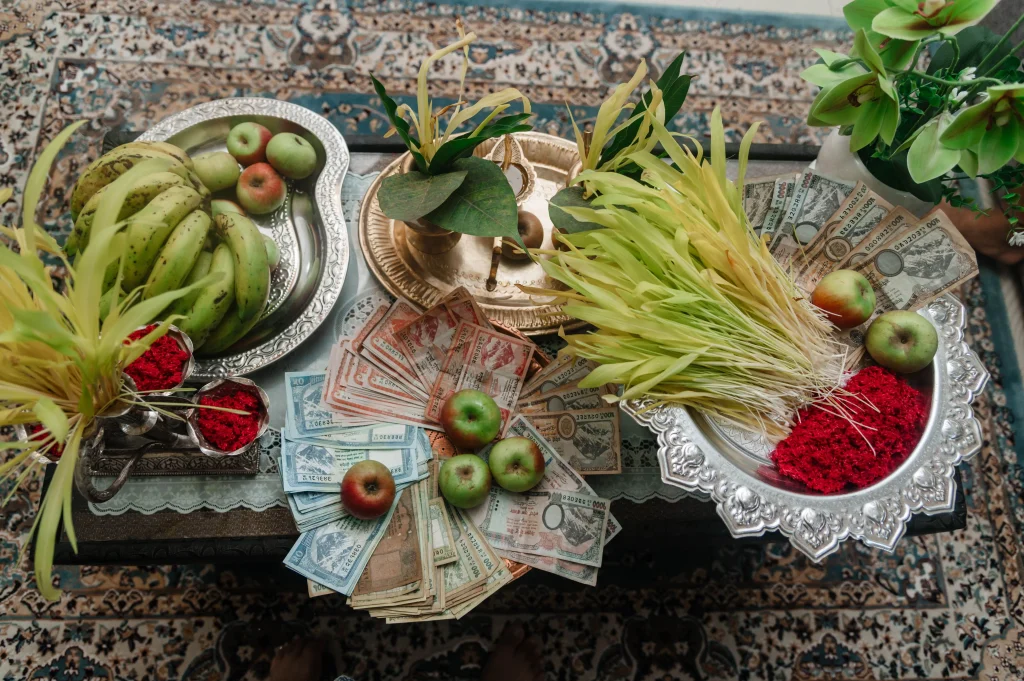
The festival opens with Ghatasthapana, which means “placing the sacred pot.” Families set up a kalash (holy water vessel) in the prayer room and sow barley seeds in sand and soil. The seeds are watered daily and kept away from sunlight. By Dashami they have grown into pale yellow shoots called jamara, which are worn on the head or behind the ear as the goddess’s blessing.
Fulpati
On the seventh day, a sacred offering of flowers, leaves and grains is carried to Kathmandu from Gorkha, the ancestral home of Nepal’s former royal family. The Fulpati procession arrives at the old palace area at Hanuman Dhoka, part of the UNESCO-listed Kathmandu Valley, with music, ceremony and large crowds.
Maha Ashtami and Maha Navami
Temples dedicated to Durga and Kali are crowded with devotees. Rituals are performed through the night, and in some traditions animal offerings are made. On Navami, many families also hold a vehicle puja, decorating cars, motorbikes, trucks and even rickshaws with marigolds and tika for protection in the year ahead.
Vijaya Dashami and the Tika Ceremony
Dashami is the emotional peak of the Dashain festival. Elders prepare tika, a mixture of rice, yogurt and red vermilion. They press it onto the foreheads of younger relatives, place jamara in their hair, and give dakshina (blessing money) along with wishes for a prosperous year. Families often travel for days to receive tika from the oldest member of the clan, which is why buses, flights and highways are so full before the Dashain festival.
Kites, Swings and Feasts
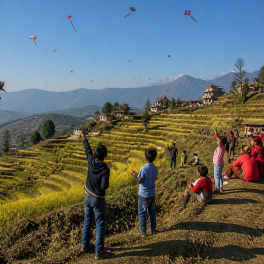
Throughout the festival, bamboo swings (ping) are built in villages and open fields, and children and adults take turns on them. Kites crowd the sky. Families cook goat curry (khasi ko masu), sel roti and sweets, and play cards late into the evening. Visitors invited into a home are usually offered food, a gesture of real warmth.

How Different Ethnic Communities Celebrate the Dashain Festival.
Nepal is home to more than 120 ethnic and caste groups, and the Dashain festival is not observed identically by all of them. Some communities treat it as their biggest festival, others as a social holiday, and some follow their own sacred calendar. Here is a respectful overview.
Bahun-Chhetri Communities.
For many Hill Hindu families, the Dashain festival is the most important event of the year. They plant jamara, worship Durga, take tika from the eldest relatives, and visit extended family. The ritual order described above is closest to how these households celebrate.
Newar Community (Mohani).
In the Kathmandu Valley, the Newars call the festival Mohani and keep some of its most elaborate traditions. The goddess Taleju Bhawani is central, and her temples open to the public on Dashami. In Bhaktapur, masked dancers perform as the Nava Durga, the nine forms of the goddess, in processions and ritual dances. Newar families hold large feasts and gather to exchange blessings.
Magar and Gurung Communities.
These hill communities, known worldwide for their Gurkha soldiers and trekking hospitality, usually celebrate with tika, feasts and family visits. The Dashain festival carries extra meaning for families who have sons and daughters in the army or working abroad, because it is often the only time they return home. Many Gurung villages on the Annapurna trails fill with returning relatives.
Madhesi Communities of the Terai.
In the southern plains, the Dashain festival is closer to Durga Puja. Maithili, Bhojpuri and other communities set up decorated pandals (temporary shrines) for the goddess, worship her through all nine days, and end with processions on Dashami. Many families fast during Navaratri.
Tharu Community
The Tharu people of the Terai have their own important festivals, such as Maghi, Jitiya and Atwari. Many Tharu families also take part in Dashain, often blending it with their own ancestral and nature worship.
Rai and Limbu (Kirat) Communities
In eastern Nepal, many Kirat families follow their own religion, Kirat Mundhum, and their major festivals are different: Ubhauli and Udhauli for the Rai, and Chasok Tangnam for the Limbu. Practice varies from family to family. Some observe Dashain mainly as a social holiday, some keep it low-key, and some do not observe it at all.
Tamang, Sherpa and Other Buddhist Communities
For many Himalayan Buddhist communities, Lhosar (New Year) is the biggest festival. In Sherpa areas, Mani Rimdu and Dumji are the major events. Some Tamang and Buddhist families join in the Dashain festival, especially in mixed towns, while others treat it only as a public holiday.
The takeaway is that Dashain is Nepal’s national festival but not its only one. That diversity is part of what makes the country so rewarding to explore on foot.
Why Trek During the Dashain Festival? What You’ll See and Enjoy.
Choosing trekking in Nepal during Dashain gives you the rare combination of spectacular scenery and living culture.
1. Crystal-Clear Mountain Views.
The monsoon rains wash dust and haze from the sky. In the weeks around the Dashain festival and just after, mornings are often completely clear, and peaks such as Annapurna, Dhaulagiri, Manaslu, Langtang Lirung and Everest stand sharply against deep blue. Sunrise at viewpoints like Poon Hill and Kala Patthar is at its best in autumn.
2. Green Hills and Golden Terraces.
The slopes are still lush from the rains, and streams and waterfalls run full. On lower trails you’ll pass rice terraces turning gold as farmers cut and dry the harvest. It’s a dream season for photographers.
3. Festival Life Along the Trail.
In villages you may see bamboo swings at the village edge, kites above rooftops, houses decorated with marigolds, jamara shoots worn on heads, and families preparing tika, goat curry and sel roti. Your guide and porters will gladly explain and may invite you to join in.
4. A Real Cultural Connection.
The Dashain festival is when Nepalis go home. Trekking now lets you see villages full of returning relatives, grandparents surrounded by grandchildren, and a spirit of generosity. If someone offers you tika or a plate of food, accepting is a warm way to take part.
5. Comfortable, Stable Trekking Weather.
Autumn is the most reliable season for trekking in Nepal. Days are dry, visibility is excellent, and daytime temperatures are pleasant at lower altitudes. It gets cold at night higher up, so bring warm layers.
6. The Festival Season Continues.
The Dashain festival leads directly into Tihar, the festival of lights, in early November. With good planning, you can see marigold garlands, oil lamps and rangoli in the same trip.
Best Treks During the Dashain Festival Season.
Annapurna region. Visit Gurung villages such as Ghandruk and Chhomrong, with festival atmosphere, terraced farms and the Poon Hill sunrise. Both the Annapurna Base Camp Trek and the Annapurna Circuit Trek are excellent in autumn.
Everest region. Walk through Sherpa villages with clear Himalayan skies and monasteries such as Tengboche on our Everest Base Camp Trek. Buddhist festivals like Mani Rimdu usually take place in autumn, but dates change each year.
Langtang region. Tamang villages, rhododendron forests, yak pastures and big mountain views. The Langtang Valley Trek starts close to Kathmandu, which is convenient when transport is crowded.
Manaslu and Mustang. Both offer stable autumn conditions and a deeper look at Himalayan Buddhist culture. Both need special permits, so check requirements with the Nepal Tourism Board or the Department of Tourism and plan well ahead.
Practical Tips for Trekking During the Dashain Festival.
- Book early. Millions of Nepalis travel for the Dashain festival. Buses sell out, and flights to Lukla and Pokhara can be fully booked.
- Expect some closures. Government offices, banks and some shops close for several days around Dashami. Arrange permits, cash and gear in advance.
- Respect your team’s holiday. Guides and porters want to be home for tika. A responsible trekking company plans around this, and we recommend asking any operator how they handle it.
- Carry small notes. Small denominations are useful for tips, snacks and teahouse bills when banks are closed.
- Stay flexible. Leave a spare day at each end of your itinerary in case transport shifts.
- Pack for the season. Bring layers, a warm sleeping bag, a rain shell and good boots. Our trekking gear checklist covers everything.
Etiquette for Visitors During the Dashain Festival.
- Accept tika with your right hand and a smile, and leave it on your forehead for the day if you can.
- Dress modestly when visiting temples and family homes.
- Remove your shoes before entering homes and prayer rooms.
- Ask before photographing rituals, especially inside temples.
- Remember that not every community celebrates Dashain, so avoid assuming everyone you meet does.
Frequently Asked Questions About the Dashain Festival and Trekking.
How long does the Dashain festival last?
It lasts 15 days, from the first day of the bright lunar fortnight of Ashwin to the full moon. The main public holidays cluster around days 7 to 10.
What is the main day of the Dashain festival?
Vijaya Dashami, the tenth day, when elders give tika and blessings to younger relatives.
Is it a good time to go trekking in Nepal during Dashain?
Yes. The Dashain festival falls at the start of autumn, when skies are clear and trails are at their best. Book flights and permits early and expect a few closures around Dashami.
Will trekking lodges be open during the Dashain festival?
Most teahouses along popular trails stay open, though some families close for a day or two. Your guide can confirm conditions on your route.
Can tourists take part in Dashain celebrations?
Yes. Visitors are often welcomed warmly and may be offered tika or food. Accept politely, dress modestly and ask before taking photos.
Do all Nepalis celebrate the Dashain festival?
No. It is the national festival, but many Kirat, Sherpa and other Buddhist communities have their own major festivals, and some do not observe Dashain.
Experience the Dashain Festival on Foot.
The Dashain festival is a fortnight in which an entire country goes home, shares food, gives blessings and starts the year fresh. On a trek, that spirit appears in small, unforgettable ways: a teahouse owner offering sweets, a village swing creaking in the breeze, or a porter’s face when he finally reaches his family.
Trekking in Nepal during the Dashain festival gives you sharp Himalayan views at the start of the autumn season and a festival that shows why Nepal is known for its hospitality.
Ready to plan your Dashain trek? Contact our team or browse our Nepal trekking packages, and we’ll help you choose the route, dates and permits that suit you. Write to info@thenepaltrekkingcompany.com or call 9841812218, and we’ll reply within 24 hours.